Operations
Cohort Management vs Spreadsheets for Startup Programs
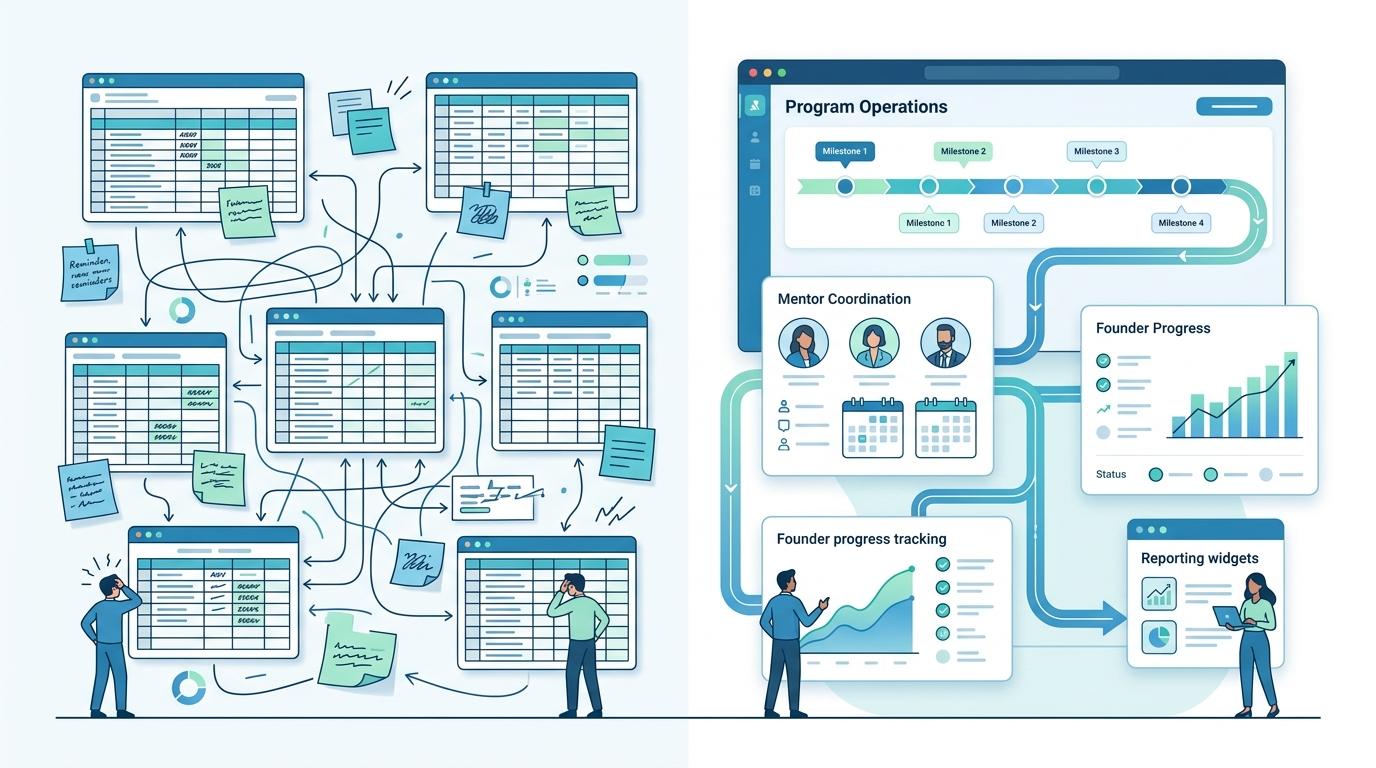
Table of contents
Where spreadsheets still work
Where cohort management starts to break
What a better operating model looks like
Table of contents
The limits of spreadsheet-led cohort tracking
How connected workflows improve startup program delivery
When it is time to move beyond manual systems
Cohort management works well in spreadsheets only for a while. For startup programs running a small pilot, a simple sheet can handle a shortlist of founders, a few milestones, and basic status notes. That makes spreadsheets useful at the start. But once a program has regular founder updates, mentor coordination, review checkpoints, and reporting expectations, the challenge changes. The issue is no longer where information sits. The issue is how teams coordinate work around it. That is where cohort management starts to strain in spreadsheets. Program Managers need visibility, leadership needs reliable reporting workflows, and founders need a smoother experience than scattered forms, follow-up emails, and disconnected trackers can usually support.
Where spreadsheets still work for small cohorts
Small pilots can live in spreadsheets. Spreadsheets still work when the cohort is small, the process is simple, and one person can stay close to every moving part. If a startup program is running an early pilot with a handful of founders, a light spreadsheet can be enough for basic cohort tracking.
In that setup, the spreadsheet is usually acting as a shared list rather than a full operating model. It can show startup names, stage, next review date, and a few notes. For a first-time program or a short experiment, that can be perfectly reasonable.
There are only a few startups in the cohort.
Mentor involvement is limited and easy to track manually.
Founder progress tracking is reviewed informally.
Reporting workflows are simple and infrequent.
The same operator handles most follow-up directly.
That matters because not every program needs software on day one. It is fair to say spreadsheets can work for small pilots, especially when the team is still learning what the program should look like. If you are defining that operating model, see How Cohort Management Helps Incubators Run Better Startup Programs and Cohort Management Best Practices for Incubators and Accelerators for a broader view of what strong cohort design looks like.
The problem is that many teams mistake early flexibility for long-term fit. A spreadsheet is good at storing rows. It is much weaker at managing coordination across people, deadlines, conversations, and decisions. That distinction becomes important as soon as the program adds more structure.
Why spreadsheets break as cohort complexity grows
Coordination is where spreadsheets fail. Spreadsheets break when the program needs coordination, not just storage. Once startup program operations depend on multiple handoffs, spreadsheets stop acting like a simple tracker and start becoming a fragile operating layer.
This usually shows up in four places first. Mentor coordination becomes inconsistent because introductions, meeting notes, and follow-ups live in different places. Milestone visibility drops because founders submit updates in mixed formats and no one sees slippage early. Founder progress tracking gets harder because the latest status depends on who last updated the sheet. Reporting workflows slow down because teams have to rebuild the same summary for leadership, partners, or funders every cycle.
In other words, the pain is not that a sheet cannot hold information. The pain is that it cannot reliably connect the work around that information.
Mentor coordination: session history, actions, and accountability are easy to lose when updates live across sheets, mail, and chat.
Milestone visibility: operators cannot quickly see which startups are on track, blocked, or overdue.
Founder updates: teams spend time chasing inputs instead of reviewing patterns and risks.
Reporting workflows: leadership asks for one view, operators rebuild it manually, and confidence in the numbers drops.
This is where spreadsheet-led cohort tracking becomes expensive in ways that are easy to miss. The cost is not the file itself. The cost is operator time, delayed interventions, and inconsistent delivery. An incubator cohort management process starts to feel reactive. Teams spend more energy stitching context together than helping founders move forward.
For leadership teams, this creates a second problem. They may see a functioning program on the surface, but not the operational drag underneath it. The real test is operating cadence, not file quality. That is the angle most generic comparison pages miss: can your team run dependable founder updates, mentor follow-up, and reporting on a weekly rhythm without rebuilding the program by hand?
What better cohort management looks like in practice
Connected workflows create operating clarity. Better cohort management creates one connected operating model for startup program delivery. Instead of treating applications, founder updates, mentor activity, milestones, and reporting as separate tasks, it brings them into one workflow with clearer ownership and visibility.
In practice, that means operators can see each startup's journey without piecing it together manually. They can review founder progress tracking in a consistent format, spot missed milestones early, coordinate mentors with context, and generate reporting workflows from live program activity instead of rebuilding updates from scratch.
A shared view of each startup across application history, milestones, mentor touchpoints, and current status.
Standard update rhythms so founder reporting is comparable across the cohort.
Clear milestone workflows with owners, deadlines, and risk visibility.
Connected reporting workflows for program teams, leadership, and external stakeholders.
This does not mean every team needs heavy process. Good cohort management software should reduce friction, not add it. The right shift is from manual coordination to connected workflows. That is why the decision is not really spreadsheets versus software as tools. It is disconnected operations versus a more reliable delivery model.
For many startup programs, the right time to move beyond spreadsheets is when the team can already see recurring coordination pain. If mentor follow-up is uneven, founder updates are hard to compare, reporting takes too long, or milestone visibility depends on one operator's memory, the program has probably outgrown spreadsheet-led cohort tracking.
SanchiAPP fits that operating model by connecting applications, cohorts, stakeholders, reporting, and governance in one place. For teams comparing approaches, How Cohort Management Helps Incubators Run Better Startup Programs gives the broader operating view, while Cohort Management Best Practices for Incubators and Accelerators shows the habits that make a connected system work in practice.
FAQ section
Yes, spreadsheets can work for cohort management when a startup program is small, the cohort is simple, and one operator can manage most follow-up directly. They tend to struggle once updates, mentors, milestones, and reporting need to stay coordinated across several people.
Incubators should move beyond spreadsheets when coordination starts consuming too much operator time. Common signals include inconsistent founder updates, weak milestone visibility, scattered mentor notes, and reporting that has to be rebuilt manually every cycle.
The main limits are not storage or flexibility. The real limits are visibility, consistency, and coordination. Spreadsheets make it hard to connect founder progress tracking, mentor activity, and reporting workflows into one reliable operating rhythm.
Software improves cohort management by connecting workflows that are usually scattered. It can standardize founder updates, make milestone tracking visible, keep mentor coordination tied to the right startup, and make reporting easier to trust and faster to produce.
Teams should compare how well a system supports cohort tracking, founder progress tracking, mentor coordination, reporting workflows, and program-level visibility. The best option should make startup program operations easier to run, not add more admin overhead.
 Made with Levo